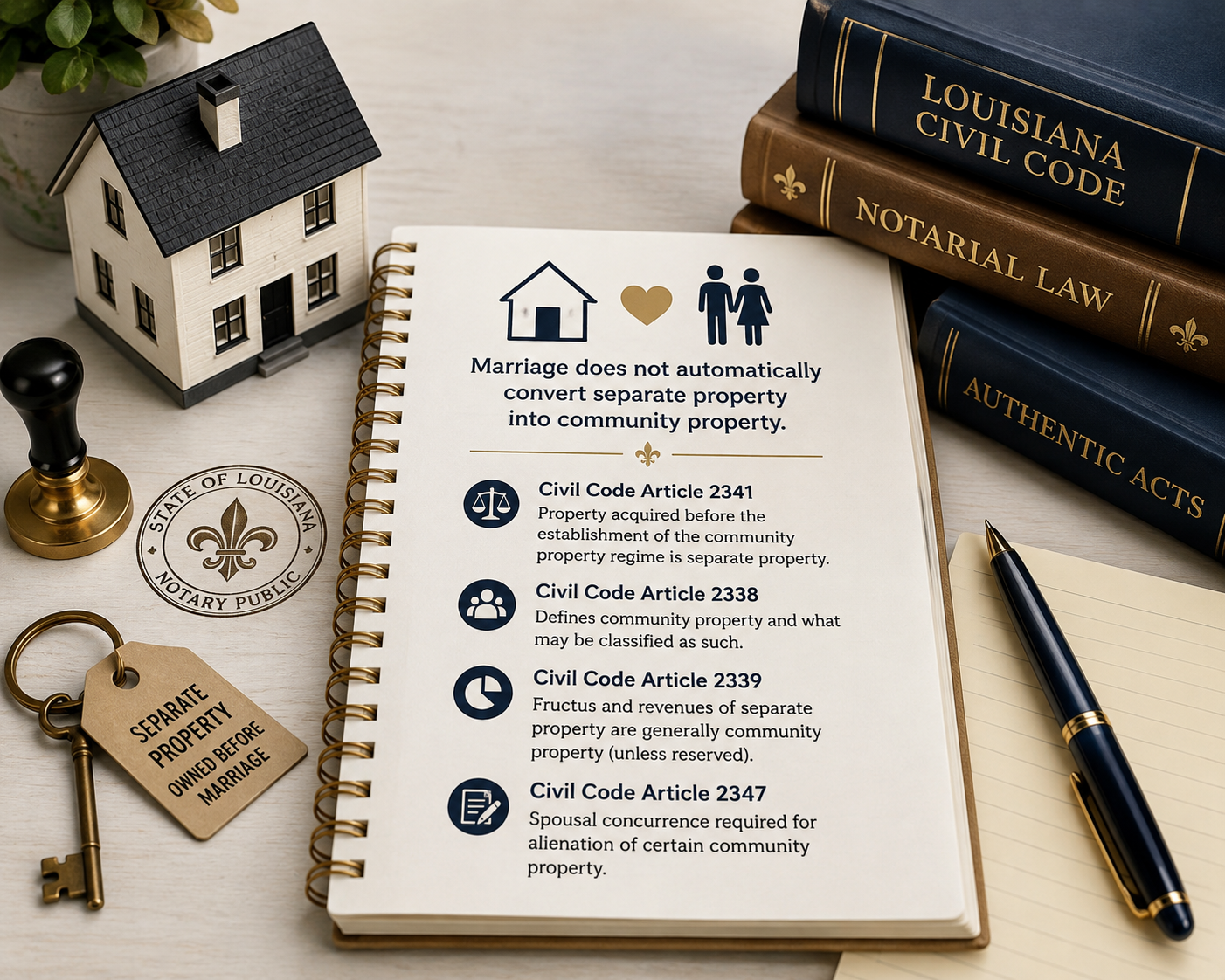
If you owned something before you got married, does saying “I do” automatically make it community property?
It sounds like a simple question.
But if you’re studying for the Louisiana Notary Exam, you already know that simple questions have a habit of leading straight into the Civil Code. 😅
So let’s work through this one.
Start With a Scenario
Marie purchases a piece of land while she is single.
Several years later, Marie marries Paul. After five years of marriage, Marie decides to sell the property.
Here’s the question:
Does the fact that Marie is now married automatically make the land community property?
A. Yes, because she is married when she sells it
B. Yes, because they’ve been married for more than one year
C. No, the land remains Marie’s separate property
D. It depends solely on whose name appears on the deed
If you chose C, you’re on the right track.
And the reason is found directly in the Louisiana Civil Code.
Louisiana Civil Code Article 2341
Louisiana Civil Code Article 2341 addresses separate property.
Among the categories of separate property identified by Article 2341 is property acquired by a spouse before the establishment of a community property regime.
That’s the important fact in our scenario.
Marie didn’t acquire the land five years into the marriage.
She didn’t acquire it on the wedding day.
She already owned it while she was single.
Her subsequent marriage to Paul does not, merely because of the marriage, transform that land into community property.

Read Louisiana Civil Code Article 2341
But Isn’t Property Acquired During Marriage Community?
Now we’re getting to the distinction that makes this a useful study question.
Louisiana Civil Code Article 2338 defines community property and includes, among other things, property acquired during the existence of the legal regime through the effort, skill, or industry of either spouse and property acquired with community things or with community and separate things, unless classified as separate property under Article 2341.

Read Louisiana Civil Code Article 2338
For exam purposes, don’t reduce this subject to:
Married = community property.
That’s much too broad.
Instead, when you’re given a property-classification scenario, start asking questions such as:
- When was the property acquired?
- How was it acquired?
- What property regime existed at the time?
- Is there a Civil Code provision classifying it as separate property?
Those details matter.
Here’s Where It Gets More Interesting
There’s another distinction worth knowing.
The property itself and the fruits and revenues produced by that property aren’t necessarily classified the same way.
Louisiana Civil Code Article 2339 generally provides that the natural and civil fruits of a spouse’s separate property, as well as certain other revenues, are community property. The article also provides a mechanism by which a spouse may reserve them as separate property.
So imagine Marie’s separate property is rental property.
The underlying property may be Marie’s separate property, while the treatment of rental income generated from it raises another question.
That’s exactly why learning the reasoning behind these classifications is more useful than memorizing:
“Property before marriage = separate.”
That’s a useful starting rule.
It isn’t the end of the subject.

Read Louisiana Civil Code Article 2339
What About Selling the Property?
Here’s another place where students can accidentally combine two different concepts.
Louisiana Civil Code Article 2347 contains concurrence requirements for the alienation, encumbrance, or lease of certain community property, including community immovables.
But notice what we had to determine first:
Is Marie’s land community property in the first place?
In our simple scenario, Article 2341 tells us that the land she acquired before the community regime is her separate property.
This is a good example of why classification comes first. Don’t jump immediately to rules governing the management or disposition of community property before determining whether you’re actually dealing with community property.

Read Louisiana Civil Code Article 2347
The Exam Lesson
This is exactly the kind of Louisiana notary concept where one fact can change everything.
Consider these two statements:
Marie purchased the land two years BEFORE marrying Paul.
versus:
Marie purchased the land two years AFTER marrying Paul.
Only one word changed.
But now your analysis may be completely different.
That’s why I encourage people studying for the Louisiana Notary Exam to slow down when reading scenario questions.
Don’t just identify the subject.
Identify the legally significant facts.
Ask yourself:
What fact did they give me that changes the rule I need to apply?
That’s often where the answer is hiding.
Today’s Takeaway
Marriage does not automatically convert property that a spouse already owned into community property.
For Marie’s land, the key is that she acquired it before the establishment of the community property regime, placing it within the separate-property classification addressed by Louisiana Civil Code Article 2341.
And remember: Louisiana matrimonial regimes go considerably deeper than this one rule.
The goal isn’t simply to memorize “before marriage = separate.”
The goal is to understand why the property is classified that way—and to recognize when a different set of facts requires you to look somewhere else in the Code.
That’s how you start turning Louisiana notarial law from a giant collection of rules into something you can actually reason through. ⚜️
This article is intended as supplemental study content and general information. When studying Louisiana notarial law, always consult the applicable current law and official study materials.
Leave a Reply