Louisiana Notary Exam
-

When You Get Married, Does Your Separate Property Become Community Property in Louisiana?
Louisiana Civil Code Article 2341 clarifies that property acquired by a spouse before marriage remains separate property, regardless of the marriage. This principle ensures that individual assets are protected and preserved. Marie’s land remains her separate property, demonstrating the importance of understanding the nuances of property classification in the context of marriage.
-

Authentic Act vs. Acknowledged Act: They Are NOT the Same Thing
Discover the important difference between an authentic act and an acknowledged act in Louisiana. Learn what each requires, why the distinction matters, and how understanding the formalities can help you avoid common Louisiana Notary Exam traps.
-
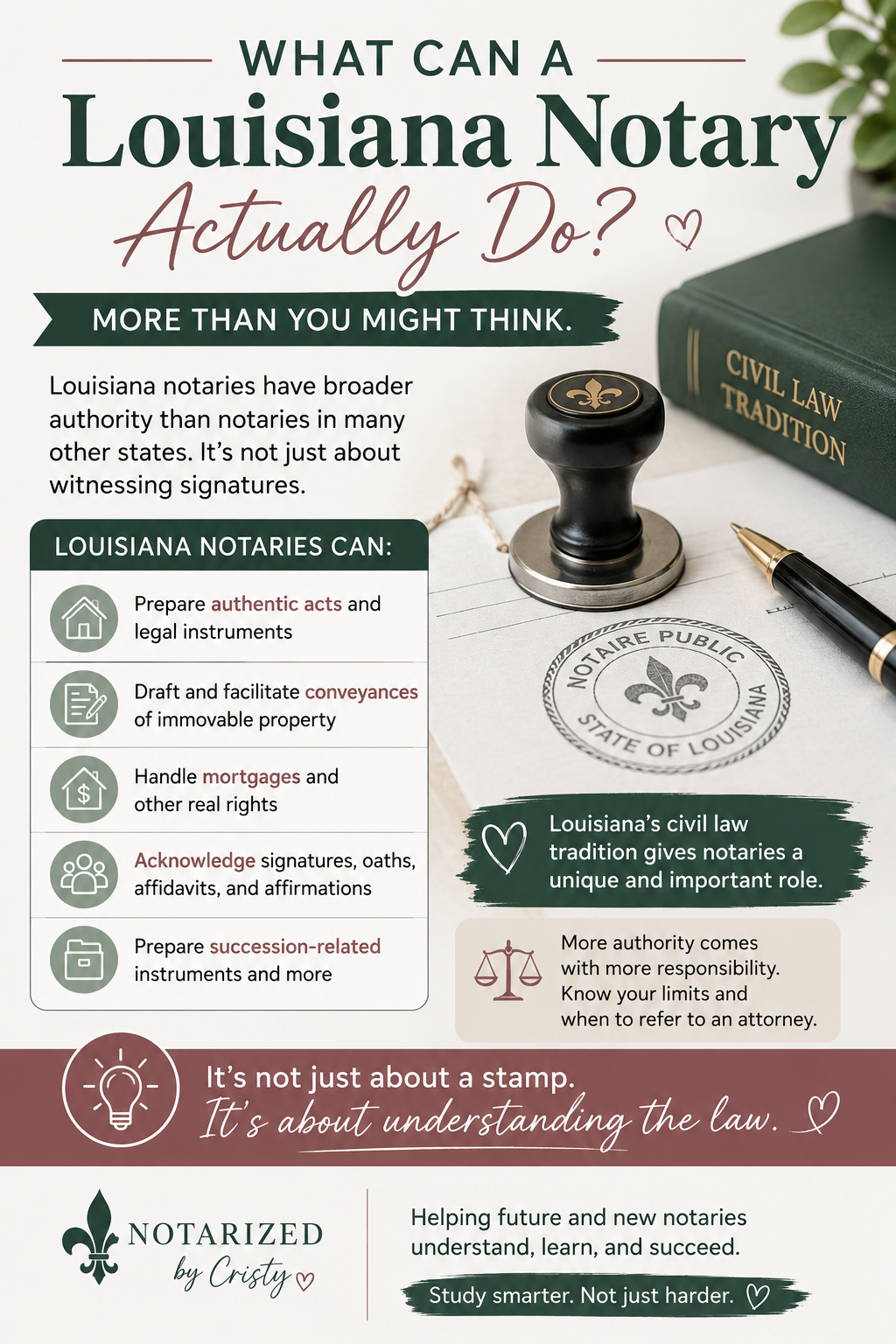
What Can a Louisiana Notary Actually Do? More Than You Might Think
Discover what makes Louisiana notaries different. From authentic acts and property conveyances to mortgages and more, explore the broad authority Louisiana notaries have—and why understanding the law is about much more than witnessing a signature.
-
Why Does Civil Law Prioritize Formal Certainty Over Litigation?
Civil law systems, such as Louisiana’s, prioritize preventing disputes through formal certainty at the execution of acts. Unlike common law, which resolves conflicts reactively, civil law emphasizes structured transactions to ensure clarity and reduce ambiguity. This approach fosters property protection, minimizes litigation, and enhances public trust in legal relationships.